Ms. Azar's Diabetes Success Story
Ms. A.S., 56 years old, who was diagnosed with diabetes in 1383 (2004) (18 years ago), and has been injecting insulin since 2013 (1392). She joined the Ketonia medical commission on 28 Khordad 1401 (June 2022); the patient's history was as follows:
- She has had high blood pressure for many years and takes medication.
- · She has a history of cataract surgery.
- Her eye bled due to diabetes complications, and she has had five or six intravitreal injections.
- She still complains of pain in her left hand, especially in the fingertips.
- She has joint dryness and stiffness with limited movement.
- Because of knee pain she cannot walk and does not exercise.
- In the last ten days she gained 2 kg.
- She has excessive thirst, frequent urination, tingling in her lower limbs, urinary infections, and hair loss on the lower limbs.
- For 2 to 3 years she has had nighttime urination, which causes repeated waking during the night, has reduced her sleep quality, and she feels nervous tension during the day, which seemsto be due to her sleep quality.
- Her feet burn at night and she feels pain.
- She is highly stressed, nibbles at food, and eats very quickly.
- In 2013 (1392), due to her father's death, the stress that followed, and consequently high blood sugars, her teeth were severely damaged by diabetes.
- She complains of wounds on her body that are painful and have not healed for some time.
- She has severe blood sugar fluctuations and usually feels weak when her sugar is below 140.
- She has persistent pain under the right ribs, and the pain radiates to the area between the shoulder blades.
- Chronic constipation — she has it and suffers greatly from it.
- The patient's medications at the start of treatment:
- Duloxetine 30 mg, once a day
- Losartan-H, twice a day
- Synripa 5/500 (empagliflozin 5 mg / metformin hydrochloride 500 mg), twice a day
- Atorvastatin 20, twice a day
- Lantus insulin 40 units once a day, 12 units of NovoRapid 3 times a day
- Vitamin B1
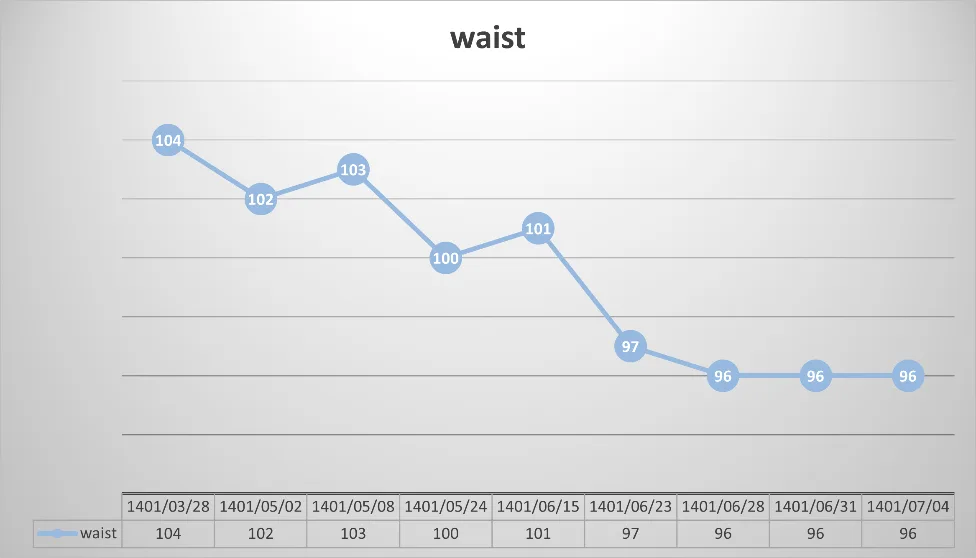
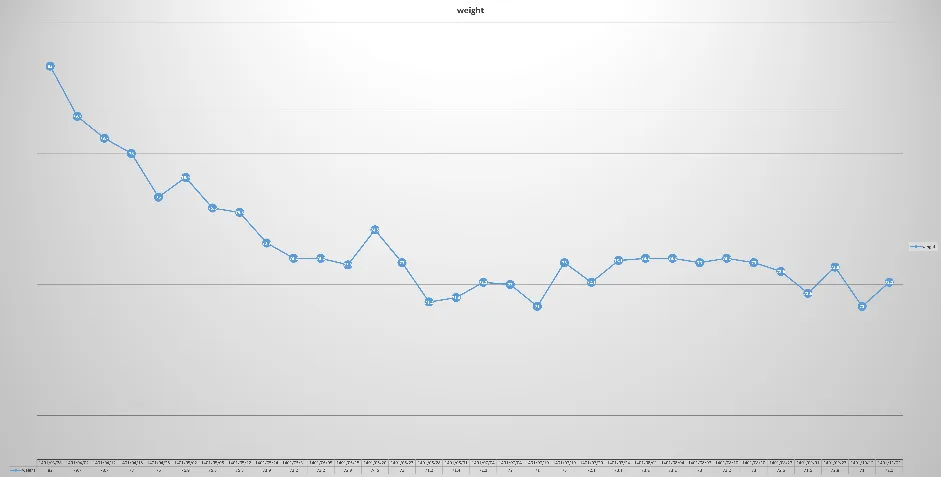
- At the commission, her weight was recorded as 82 kg, height 154 cm, BMI 34.5, waist 114 cm, and hip 102 cm.
- In the blood test of 18-10-1400 (January 2022), the patient's fasting glucose was 275, 2-hour 352, and hemoglobin A1c: (HbA1C) 10.6, triglycerides 144, total cholesterol 181, and cholesterol HDL: 46, and cholesterol LDL: 104, were recorded.
With the explanations given at the Ketonia medical commission, the patient was very interested in joining the Ketonia program. The Ketonia team therefore began its training and programs for correcting the patient's lifestyle (nutrition, sleep, exercise, mental health, and medical care) right away.
- About one week into the Ketonia team's lifestyle training, with medication adjustment and the patient's good cooperation, her blood sugar fluctuations were controlled. The patient also said that frequent urination had become much less frequent, her sleep had deepened, her hand pain had improved greatly and she no longer had cramps, and her right-hand finger was much better. She also happily said she felt far less hungry — before, she had to eat breakfast immediately after waking or became ravenously hungry by noon and had to eat, or she would feel weak and unable to stand — but now she does not feel excessive hunger at all and can delay a meal for one or two hours after waking without any problem. Based on these points, on the same day, by the Ketonia commission's decision, the short-acting insulin was removed.
- In the second week, the patient said that previously she could never sleep this long through the night — she woke every two hours both from foot pain and to urinate — but now she is very happy with her sleep. Her foot pain and wounds have also improved.
- In the fourth week, the patient stated that with the training, the diet, and the medication adjustments, her constipation and thigh pain had improved.
- After two months of treatment, based on her results, the insulin was discontinued and replaced with Synripa — one tablet in the morning and one at night — and metformin 1000, one at noon.
- Two weeks after stopping insulin, the patient's treatment was progressing well when, unfortunately, because she contracted COVID-19 and after reviewing her glucose reports, the Ketonia commission had to re-prescribe insulin. But the Ketonia team remained hopeful that with successful weight loss they could stop the insulin again.
- After roughly seven months of treatment with healthy lifestyle training and the Ketonia team's supervision, she has now been able to control her diabetes and reduce many problems including frequent urination and neuropathy. During this period the patient contracted COVID-19 three times, and considering the existing risks and the patient's high exposure to diseases such as influenza and COVID, the Ketonia commission decided that insulin should be injected for now, hoping that with the patient's cooperation and continued training, in the future her blood sugars can be controlled and reduced through lifestyle correction so that insulin injections will not be needed.
- The patient's current medications:
- Ciprofloxacin 500 — every 12 hours
- Metformin/linagliptin 1000/5 — every 12 hours
- Losartan 50 — one tablet in the morning
- ASA one tablet at noon after lunch
- Atorvastatin 20 — one tablet at night
- Ursodox (ursodeoxycholic acid) 500 — one tablet at noon
- Vitamin B1 one tablet at noon
- Omega-3 — two per week
- Escitalopram 10 — one tablet in the morning
- Long-acting insulin — 10 units at night and 20 units in the morning
- Pantoprazole 40 mg — one tablet daily
- According to the survey, the patient said that previously she had low blood sugar after meals and insulin injections and constantly felt hungry, but during these 7 months, with the Ketonia team's diet and training, she has not had this problem and her sugars are under control. Despite the appropriate weight loss, fortunately the loss has been principled and without complications, which has reduced her knee pain; she now walks daily and even does anaerobic exercises at home. In addition, with much of the training she has improved her digestive problems and, compared with the start of treatment, is in a far better mental state.
- After roughly seven months of treatment and the Ketonia team's lifestyle training, her weight was recorded as 72 (a 10 kg decrease) and waist 96 (an 18 cm decrease), indicating significant changes in her laboratory and anthropometric indicators.
- The patient is now following the Ketonia program and has been able to greatly improve her metabolic syndrome and diabetes with the team's support, and has been spared many of the complications of blood sugar fluctuations. She has controlled her blood pressure, experienced a 12 kg weight loss, and with improvements in her laboratory and anthropometric indicators, after roughly 9 years of insulin injections, she has succeeded in reducing its dose.